Where the magnetic field is chosen to be parallel to the -axis, is the -component of the angular momentum operator, and is the charge and mass of the electron. The used system is GCGS.
is the Hamiltonian of the hydrogen atom:
Whose eigenfunctions are and the energy levels are proportional to .
How does the total Hamiltonian act on ?
Thus, the eigenstates of the hydrogen atom are also eigenfunctions of with the following energy eigenvalues:
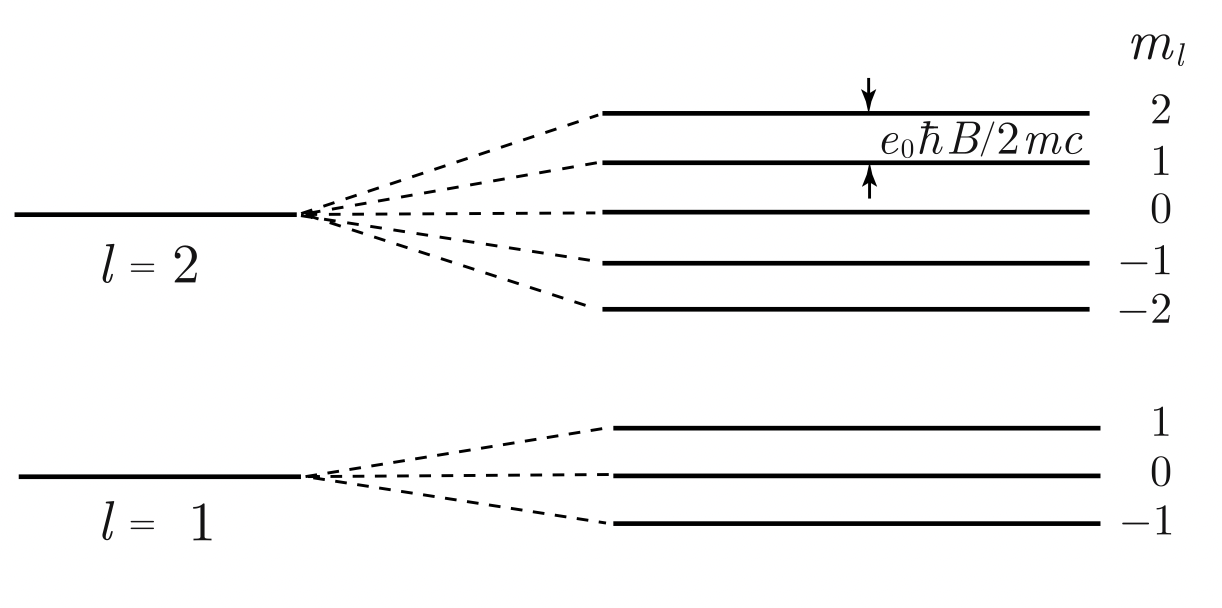
The magnetic field removes the -fold degeneracy of the energy levels. A level with angular momentum quantum number is split into equidistant levels. The magnitude of the splitting is:
The splitting leads to additional transitions, which however are restricted by the selection rule . This equidistant splitting caused by the magnetic field is called the normal Zeeman effect.
In many-electron atoms, refers to the total angular momentum and to the corresponding quantum number.